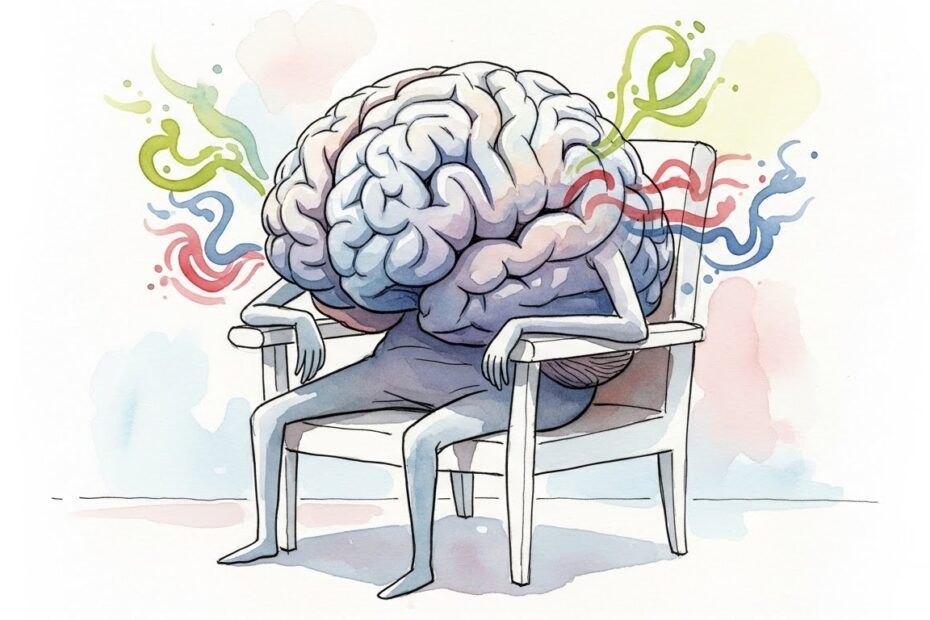
TL;DR: Scientists have discovered a physical “brake” in the brain that stops us from starting stressful tasks, whilst gifted dogs are learning to understand spelt-out words to eavesdrop on their owners, and swearing aloud can actually make you physically stronger. Meanwhile, a new AI model predicts 100 diseases from a single night’s sleep, teenagers lose over an hour of every school day to social media scrolling, and “pseudo-empathy” machines are proposed to solve the global therapist shortage. Plus: Premium dog food is discovered to have a higher “carbon pawprint” than many human diets, brands are urged to monitor Bluesky for unfiltered consumer truth, and a major review confirms that digital socialising is no substitute for face-to-face connection.
Scientists find ‘brake’ in the brain that stops us starting stressful tasks
We all know the feeling: staring at a difficult email, fully aware of what needs to be done, yet physically unable to push the mental “go” button. Now, scientists in Japan believe they have found the biological reason why.
A research team at Kyoto University has identified a specific neural pathway that acts as a “motivation brake,” actively stopping us from acting when a task seems stressful or unpleasant. The study, published in Current Biology, suggests that procrastination on difficult tasks is not necessarily a failure of willpower, but a specific function of a brain circuit (the VS-VP pathway) weighing cost against benefit.
By manipulating this pathway in monkeys, researchers could make them immediately willing to perform unpleasant tasks (in this case, receiving a puff of air to the face) to get a reward. While this offers hope for treating “avolition” in depression, the scientists warn that the brake is essential for preventing severe burnout by stopping us from taking on too much.
Spelling out ‘W-A-L-K’ might be wise as gifted dogs eavesdrop to learn words
Owners who spell out words like P-A-R-K or V-E-T to keep secrets from their pets may need a new code, as a study reveals that “gifted” dogs can learn to understand spelled-out words.
Researchers found that dogs with an exceptional ability to learn object names can also recognise the component letters of words they know, effectively “eavesdropping” on human conversations. The findings suggest that canine linguistic processing is far more sophisticated than previously thought, with the ability to map sequences of sounds to real-world concepts.
You can swear by it: Turning the air blue makes you stronger, psychologists find
Unleashing a string of expletives might be the secret to hitting a personal best in the gym, as psychologists find that swearing can significantly boost physical strength.
A study testing grip force and exercise performance revealed that participants who swore aloud were able to exert more power than those who used neutral words. The researchers suggest that swearing may trigger the body’s “fight or flight” response, releasing adrenaline and bypassing neural inhibition systems that normally limit muscle output to prevent injury.
https://thefreesheet.com/2025/12/31/turning-the-air-blue-makes-you-stronger-psychologists-find
Artificial intelligence predicts 100 diseases from a single night’s sleep
A new artificial intelligence model can forecast a person’s risk of developing nearly 100 different diseases by analysing data from just a single night of sleep.
The tool uses “sleepome” data—complex patterns in breathing, heart rate, and movement—to identify early warning signs of conditions ranging from diabetes to cardiovascular disease. Researchers believe this non-invasive approach could revolutionise preventative medicine, turning routine sleep monitoring into a powerful diagnostic check-up.
Teens lose over an hour of school day to social media scrolling
US teenagers are spending more than an hour of every school day engaged with social media, according to a concerning new report on digital distraction in education.
The data highlights a significant “attention deficit” in classrooms, where students are physically present but mentally absent, scrolling through TikTok, Instagram, and Snapchat. Educators warn that this fragmentation of focus is contributing to learning loss and increased anxiety, prompting calls for stricter phone-free policies in schools.
https://thefreesheet.com/2026/01/08/teens-lose-over-an-hour-of-school-day-to-social-media-scrolling
‘Pseudo-empathy’ machines proposed to solve therapist shortage
Machines capable of simulating emotional responses without actually experiencing them could be the answer to the global mental health crisis, researchers suggest.
The concept of “pseudo-empathy” involves AI systems designed to validate and respond to human emotions in a therapeutic setting, filling the gap left by a critical shortage of human practitioners. While ethical concerns remain about the “authenticity” of the care, proponents argue that for many patients, a convincing simulation of empathy is better than no support at all.
https://thefreesheet.com/2026/01/07/pseudo-empathy-machines-proposed-to-solve-therapist-shortage
Dog food ‘carbon pawprint’ can carry higher climate cost than owners’ diets
Feeding the family dog premium, meat-rich steaks and wet food may cause more environmental damage than the diet of the owner, according to a new analysis of the pet food industry.
Researchers calculated the “carbon pawprint” of various dog diets, finding that the trend towards “human-grade” meat for pets significantly drives up emissions. The study suggests that environmentally conscious owners should consider insect-based or dry food alternatives, which offer similar nutritional value with a fraction of the climate impact.
Brands urged to monitor Bluesky and Mastodon for ‘unfiltered’ consumer truth
Companies seeking honest feedback on their products should look beyond Facebook and X (formerly Twitter) to decentralised platforms like Bluesky and Mastodon.
Marketing experts argue that these newer, less algorithmically curated spaces offer a vein of “unfiltered” consumer truth that is increasingly rare on mainstream platforms dominated by bots and ad-friendly content. Monitoring these communities can provide brands with early warning signals about reputation issues and genuine customer sentiment.
Digital ‘socialising alone’ no substitute for face-to-face connection
A comprehensive review of more than 1,000 studies has confirmed that while digital tools keep us connected, they are no substitute for the biological benefits of face-to-face interaction.
The research highlights that “socialising alone”—interacting with others through screens—fails to trigger the same release of oxytocin and endorphins associated with physical presence. The findings serve as a warning that a reliance on digital communication may be contributing to an epidemic of loneliness despite our hyper-connectivity.